




A plug-in principle for prompt optimization in multi-agent systems: decompose prompts into a shared coordinator and per-agent executors, optimize each for its role, with any optimizer.
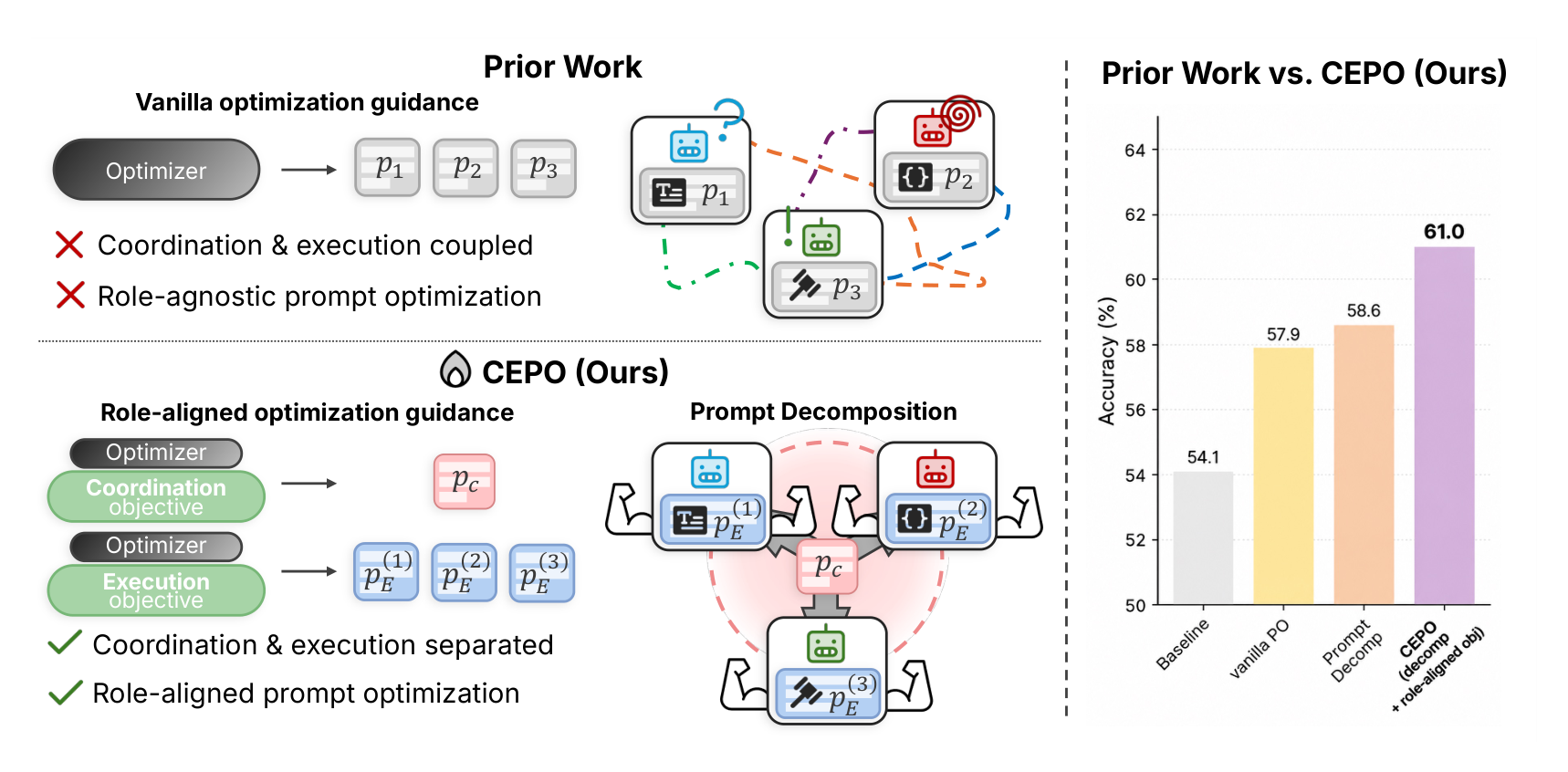
Split every agent prompt into one shared coordinator prompt (how the team collaborates) and per-agent executor prompts (how each agent does its job), and optimize each for its role.
CEPO only specifies the prompt structure and the optimization guidance; the search is done by the optimizer you already use, with no modification. PE2OPROProTeGiMASPO
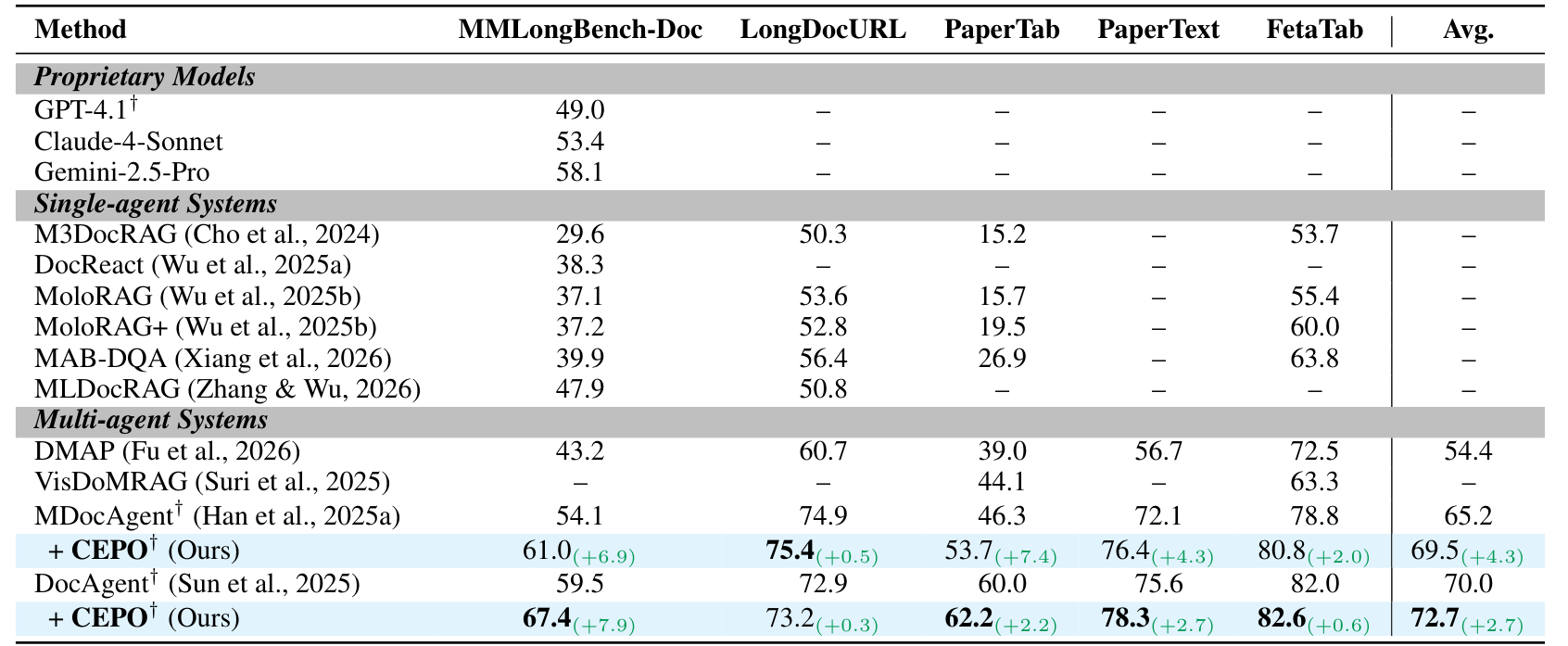
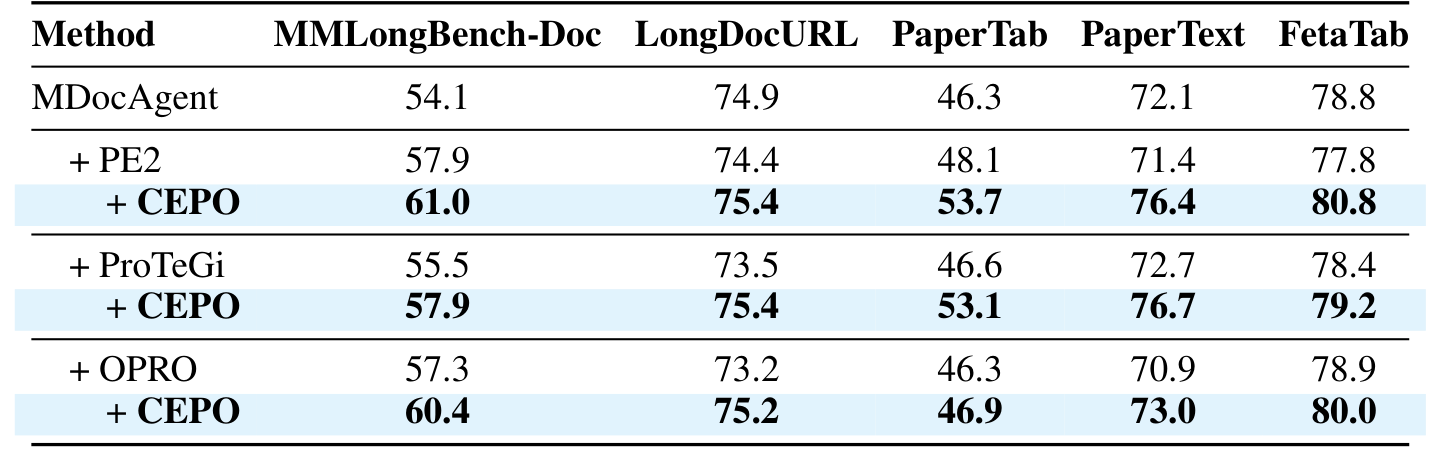
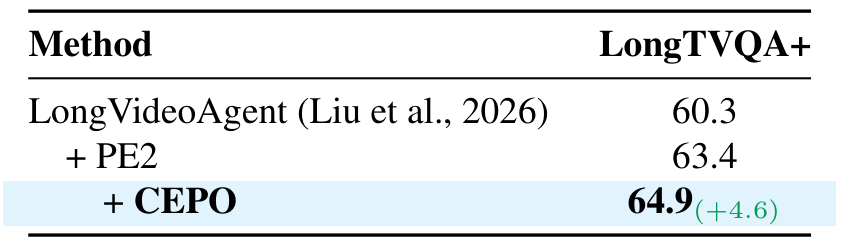
26 / 26 optimizer × system × benchmark settings improve across 11 benchmarks, 4 domains, 4 multi-agent systems and 4 optimizers. Document +4.3Math · Code +5.1Video +4.6
Each prompt gets better alone, but the rules the team shares (hand-offs, conflict flagging, what to cite) are buried in every prompt, get optimized separately, and drift apart. CEPO pulls them out into one coordinator prompt that every agent receives.
Multi-agent systems (MAS) require both effective coordination and specialized task execution. Existing prompt optimization approaches typically couple these functions within agent-specific prompts. We introduce Coordinator-Executor Prompt Optimization (CEPO), a general framework for improving prompt optimization in MAS. CEPO separates system-level coordination from agent-level execution through a shared coordinator prompt and agent-specific executor prompts, and guides their updates according to their respective roles. This structure allows shared coordination rules to be refined consistently across agents while keeping execution instructions separately adjustable. CEPO provides the prompt structure and optimization guidance, while existing prompt optimizers perform the underlying search. Extensive experiments spanning 11 benchmarks across four domains demonstrate that applying CEPO to four existing prompt optimizers consistently improves their performance. Ablations and qualitative analyses support the proposed design, while controlled studies on a document-understanding MAS further demonstrate improved optimization budget efficiency and performance scaling with the number of agents.
CEPO changes only what is optimized and the guidance for optimizing it. Candidate generation and search are left to the optimizer you already use.
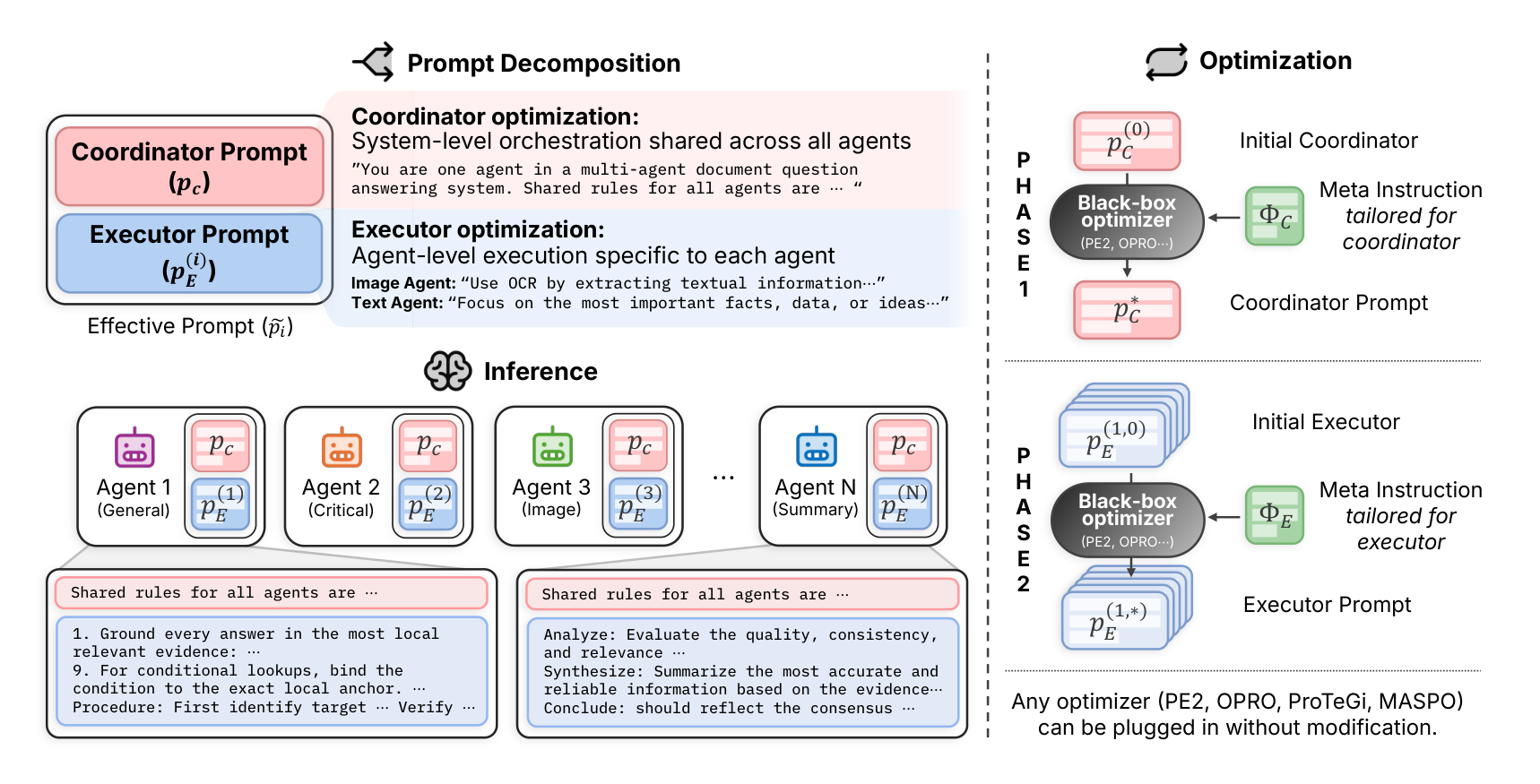
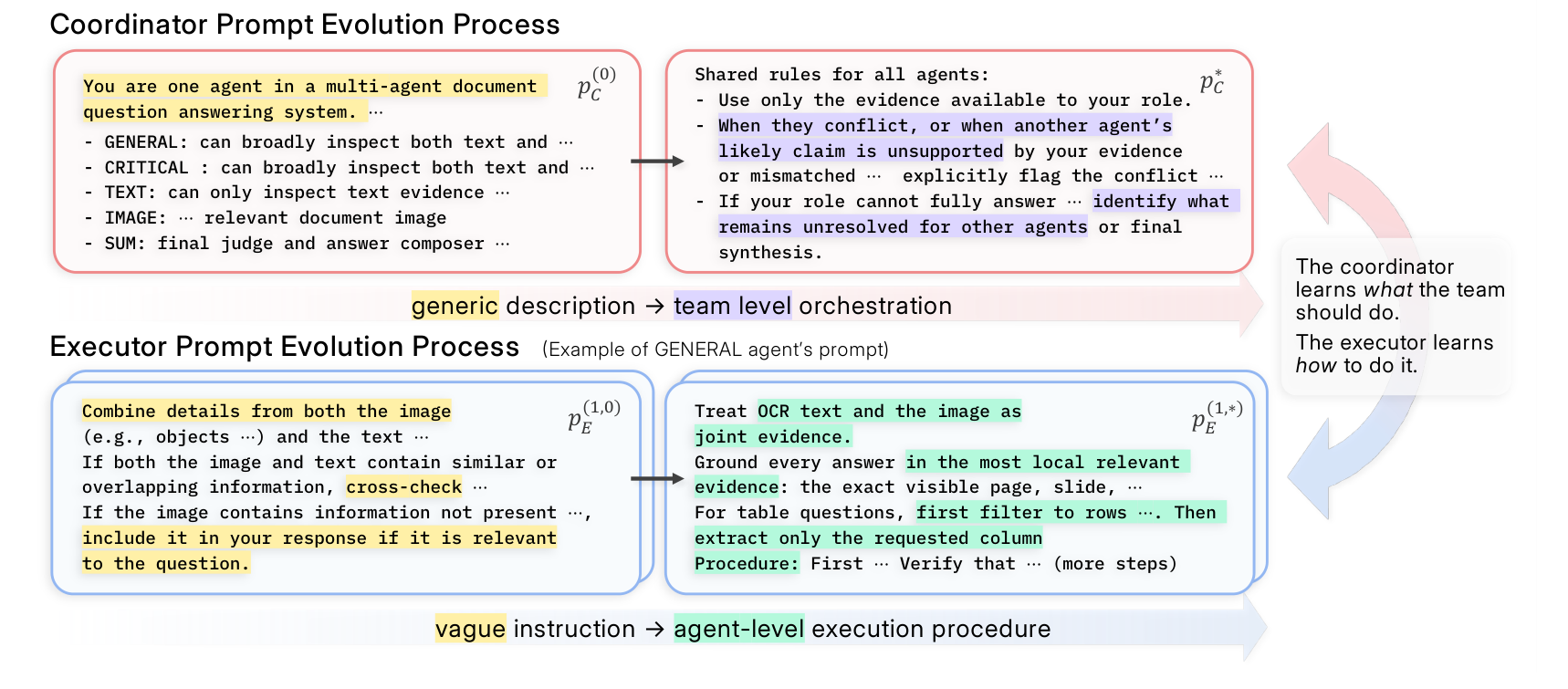
Pull shared coordination out of every agent into one coordinator prompt pC. Each agent keeps an executor prompt pE(i); at inference agent Ai receives pC ⊕ pE(i). Updating pC changes the shared instructions of all agents at once; updating pE(i) changes only one agent’s local instructions.
Optimize each layer for its role with distinct meta-instructions. ΦC steers the coordinator toward team-level collaboration (cross-agent communication, conflicting evidence, shared reasoning norms); ΦE steers each executor toward its own task (task scoping, evidence use, concrete procedures). The coordinator learns what the team should do; the executor learns how to do it.
Initialize executor prompts from the system’s default prompts; let an LLM draft an initial coordinator prompt from a description of the system and its agent roles.
With executors frozen, the optimizer updates pC for TC iterations under ΦC; the best iterate by system-level validation score is kept.
With pC★ frozen, selected executor prompts are updated for TE iterations under ΦE, each selected by validation.
Candidate generation and search follow the underlying optimizer. Both layers are selected by the same system-level objective; only the target and the guidance change.
pC (shared across all agents) captures coordination signals: team composition, role assignment, shared norms for reasoning. Each executor prompt pE(i) (local to agent Ai) captures execution signals: evidence anchoring, task scoping, procedure execution. The two layers are optimized sequentially with role-aligned guidance by an existing optimizer O plugged in without modification.
Applied to four prompt optimizers on four multi-agent systems, CEPO improves every optimizer × system × benchmark setting we tried.
Accuracy gain in points vs. the same optimizer without CEPO; the DocAgent row is vs. its unoptimized baseline. Hover a cell for the setting.
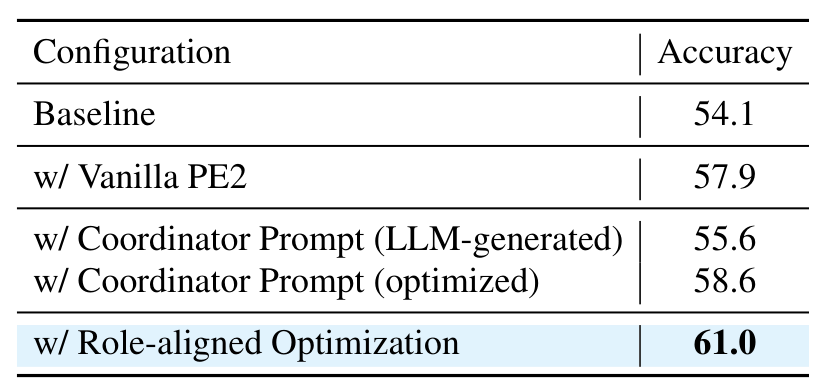
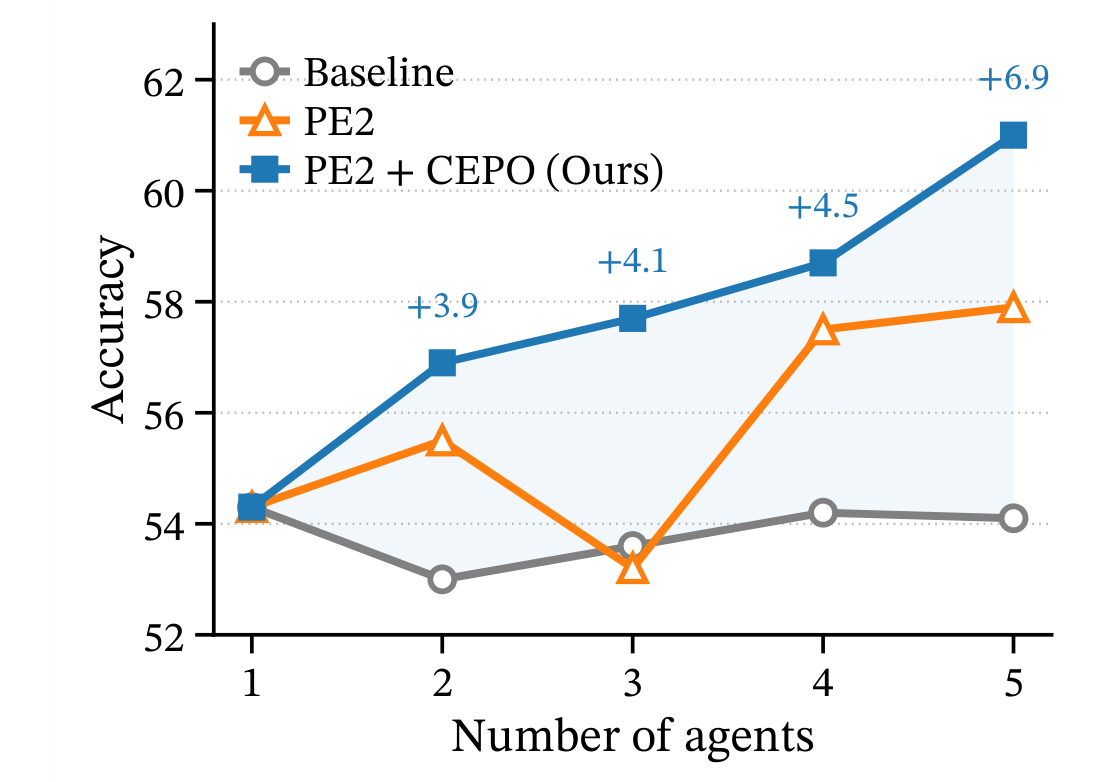
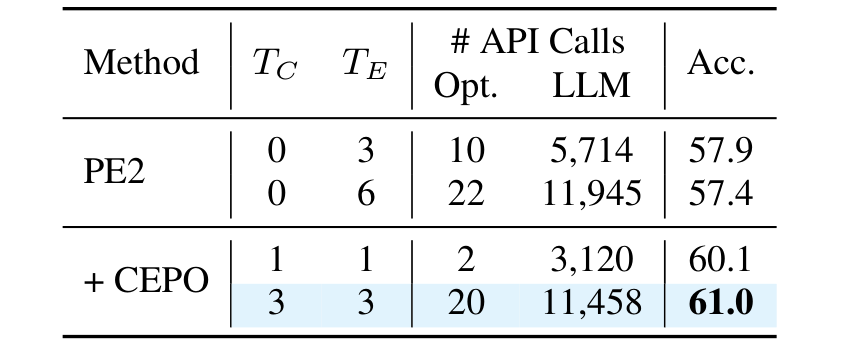
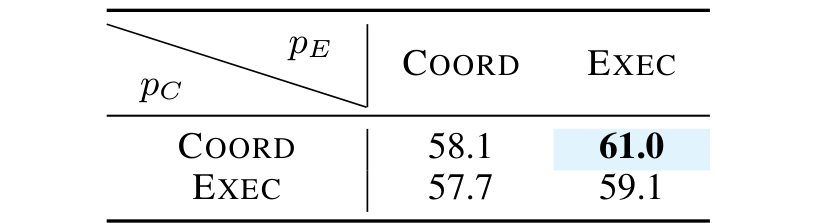
MDocAgent on MMLongBench-Doc with PE2. Both principles matter, the gains grow with the team, and CEPO reaches a higher score with fewer optimizer and MAS calls.
Component ablation, accuracy (%)
Accuracy vs. number of agents
Accuracy by training budget · bar = MAS API calls
Guidance swap · which meta-instruction goes to which layer
Decompose.Align.Plug in.
Plug CEPO into your optimizer. The structure and the guidance are the method; the search stays yours.
@article{kim2026cepo, title = {CEPO: A General Framework for Improving Prompt Optimization in Multi-Agent Systems}, author = {Kim, Jongha and Lee, Seohyun and Chung, Jonathan Minho and Yoon, Jinsung and Kim, Hyunwoo J.}, journal = {arXiv preprint arXiv:2610.34722}, year = {2026} }