NeurIPS 202640th Conference on Neural Information Processing Systems
Autoregressive video models forget whatever leaves their context window. For every new frame, CovRAG finds the regions the context no longer covers and retrieves the past frames that still cover them.
Long-horizon video generation is a key capability of video world models, yet maintaining geometric consistency remains challenging. Memory-augmented generative models address this by retrieving historical frames, but their effectiveness depends on two key design choices: what 3D-geometric evidence should represent past observations, and how memory frames should be selected from this evidence. Pose-based field-of-view overlap provides lightweight but coarse geometric evidence, while explicit 3D scene memories offer finer spatial information at the cost of geometry estimation, alignment, and incremental updates over long rollouts. We propose Coverage-Maximizing Retrieval-Augmented Generation (CovRAG), a depth-based memory retrieval framework that uses pretrained 3D priors to construct a target-view coverage map as lightweight 3D memory evidence. For frame selection, CovRAG maximizes residual coverage gain, iteratively retrieving frames that explain target-view regions not covered by the temporal context or previously selected memories. To improve scalability in long-video generation, we introduce sliding-window depth caching for efficient geometry estimation. Experiments on RealEstate10K and DL3DV10K show that CovRAG improves long-horizon geometric consistency over the evaluated memory-retrieval baselines while maintaining low retrieval latency.

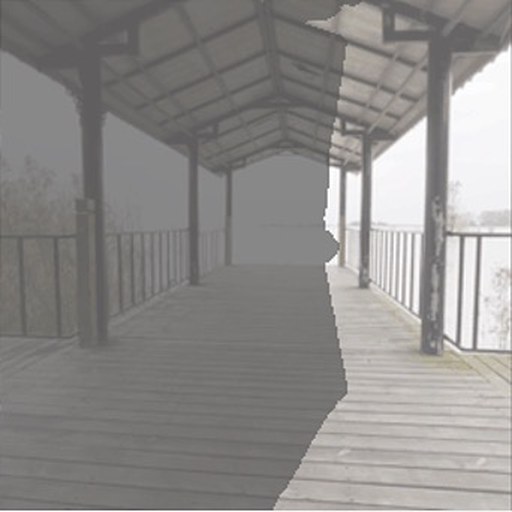
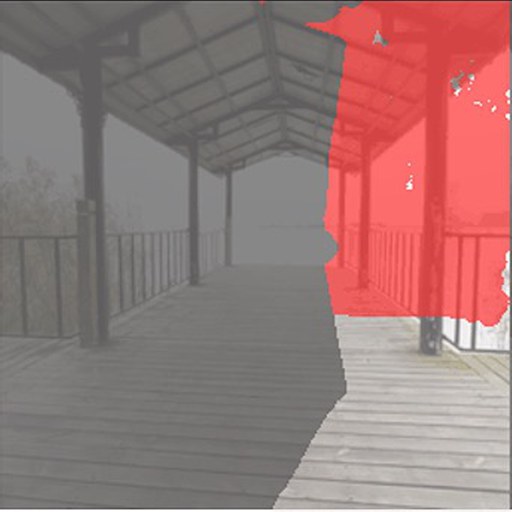
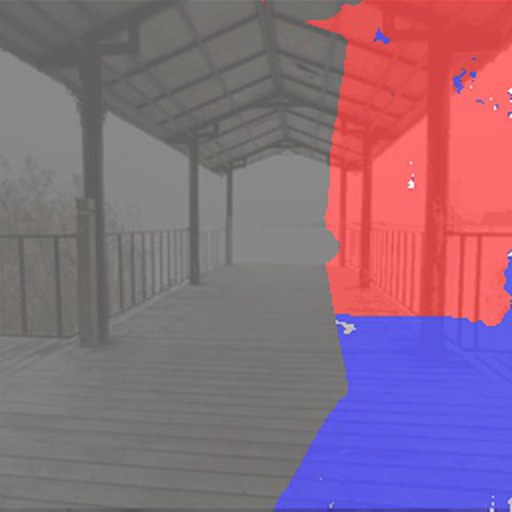
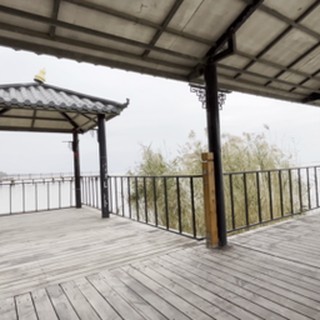
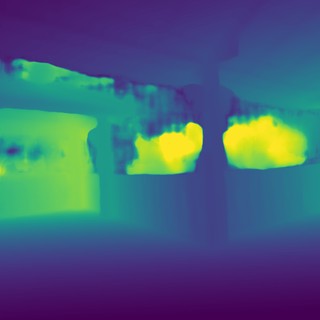
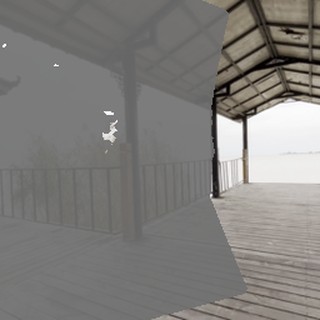
Before each frame is generated, CovRAG marks which target-view pixels the temporal context already supports, then retrieves the memories that cover the rest.


Every past frame is warped into the target view with VGGT depth and camera pose; a target pixel is covered if any source pixel lands on it.
Pixel-level evidence, with no global 3D scene to build or align.
Each candidate is scored only by the uncovered pixels it would explain; the best one is retrieved, its coverage is added, and the search repeats n times (n = 2).
Redundant frames score zero, so each retrieval covers what the previous one missed.
VGGT runs only on the latest L = 10 frames; each new frame’s depth is cached with its RGB and pose and reused for every later target view, so geometry cost per step stays bounded by L.
Retrieval reduces to warp-and-count over cached depths: no reconstruction, no alignment, no global scene.
More consistent long-horizon rollouts on both datasets. Every method shares the same backbone and memory module; only the retrieval rule differs.
| Method | Consistency | Quality | ||||
|---|---|---|---|---|---|---|
| MEt3R ↓ | LPIPS ↓ | PSNR ↑ | SSIM ↑ | FVD ↓ | FID ↓ | |
| RealEstate10K · loop closing, T = 40 | ||||||
| DFoT (no memory) | 0.415 | 0.588 | 11.7 | 0.372 | 265.03 | 29.88 |
| + WorldMem | 0.144 | 0.197 | 18.2 | 0.555 | 242.36 | 24.77 |
| + VMem | 0.120 | 0.174 | 18.6 | 0.568 | 231.77 | 24.05 |
| + Spatia | 0.140 | 0.204 | 17.9 | 0.575 | 228.68 | 22.60 |
| + CovRAG (ours) | 0.102 | 0.154 | 18.9 | 0.576 | 226.40 | 23.00 |
| DL3DV10K · original trajectories, T = 100 | ||||||
| DFoT (no memory) | 0.430 | 0.529 | 14.5 | 0.394 | 706.70 | 88.01 |
| + WorldMem | 0.316 | 0.401 | 16.2 | 0.436 | 428.49 | 58.24 |
| + VMem | 0.315 | 0.380 | 16.3 | 0.447 | 394.79 | 57.61 |
| + Spatia | 0.327 | 0.416 | 15.9 | 0.434 | 439.64 | 56.10 |
| + CovRAG (ours) | 0.224 | 0.308 | 17.9 | 0.504 | 321.81 | 46.92 |
Table 1Long-horizon revisitation consistency (MEt3R, LPIPS, PSNR, SSIM) and generation quality (FVD, FID). Best in burgundy.
Long, spatially extended camera paths through diverse scenes. Baselines drift and deform structures; CovRAG keeps the layout.
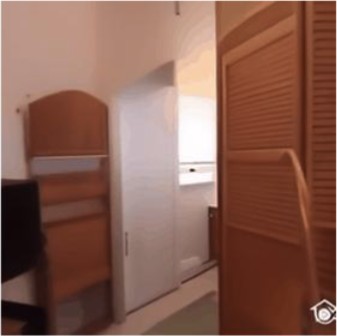
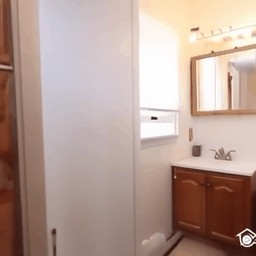
The camera returns to its first view after a long gap. CovRAG reproduces the revisited room; baselines deform or shift it.
100-frame autoregressive generations along original DL3DV10K trajectories.
CovRAG replaces the memory-selection rule of pretrained pipelines without retraining them.
Interactive world model · Dynamic scenes
| Method | PSNR ↑ | SSIM ↑ | LPIPS ↓ | FVD ↓ |
|---|---|---|---|---|
| WorldPlay-8B | 14.3 | 0.390 | 0.373 | 418.44 |
| + CovRAG | 14.9 | 0.411 | 0.333 | 376.83 |
100 rollouts of 460 frames, with people and vehicles in motion.
World foundation model · 3D conditioning
| Method | PSNR ↑ | SSIM ↑ | LPIPS ↓ | MEt3R ↓ |
|---|---|---|---|---|
| GEN3C | 14.2 | 0.572 | 0.519 | 0.377 |
| + CovRAG | 17.6 | 0.675 | 0.349 | 0.251 |
361-frame rollouts on RealEstate10K. 1.3% more compute.
Near-constant retrieval cost, both design choices matter, and the margin holds as rollouts get longer.
Same backbone and memory bank; only the retrieval rule differs.
mirror retained ✓

WorldMemFoV-based
mirror missing ✗
Scene 2
@inproceedings{joo2026covrag, title = {Retrieve What's Missing: Coverage-Maximizing Retrieval for Consistent Long Video Generation}, author = {Joo, Minseok and Park, Dogyun and Lee, Taehoon and Lee, Kyujin and Kim, Hyunwoo J.}, booktitle = {Advances in Neural Information Processing Systems, NeurIPS}, year = {2026} }