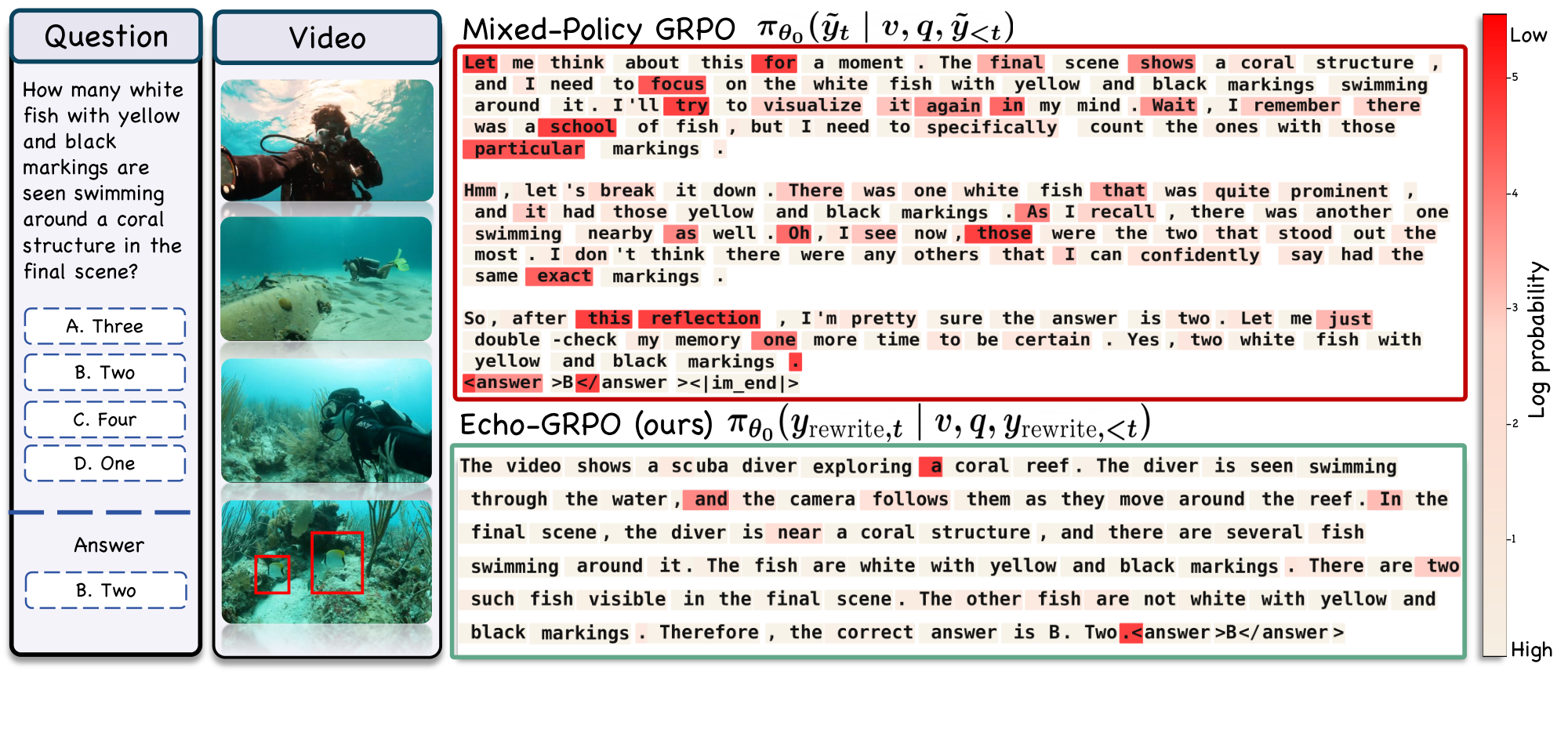
Reasoning in the words you speak. Token-level log-probabilities under the student policy
πθ₀ (red = low probability). Top: Mixed-Policy GRPO makes the student imitate a
privileged trace from a stronger teacher, leaving semantically critical tokens such as “school of fish”
in low-likelihood regions. Bottom: Echo-GRPO paraphrases the same reasoning into the student's own idiolect
(“school of fish” → “several fish”), preserving the meaning while keeping every token in-distribution.
Recent large language models achieve strong performance on complex reasoning tasks, where reinforcement learning
with Group Relative Policy Optimization (GRPO) has emerged as a leading paradigm for optimizing models on
self-generated trajectories. However, the on-policy nature of GRPO bounds the model to the reasoning skills it can
already produce, restricting it from learning more advanced capabilities. Prior works inject privileged reasoning
traces from a stronger teacher policy to guide training, yet these traces are inherently out of distribution with
respect to the student policy. We observe that this mismatch between on-policy and off-policy causes
gradient clipping on semantically critical reasoning tokens, ultimately rewarding correct answers while leaving
the reasoning that justifies them unlearned. Hence, we propose Echo-GRPO, a framework that lets the model
reason in the words it speaks. Rather than imitating low-probability privileged traces from the teacher model,
Echo-GRPO rewrites them into the student policy's own idiolect, that is, its own characteristic vocabulary and
expression patterns, while preserving their semantics via Dual-Reference Decoding. We instantiate this
framework as VideoEcho-R1 for video reasoning distillation, achieving consistent improvements across three
multimodal LLM backbones and five benchmarks. Finally, we show that our idiolectal paraphrasing is a plug-in module
that consistently improves both RL and supervised fine-tuning frameworks for reasoning distillation, demonstrating
that policy-aligned supervision extends beyond GRPO.
Contributions
What’s new
A hidden failure mode
In Mixed-Policy GRPO, trust-region clipping suppresses the gradient on semantically critical tokens of
privileged traces: the correct answer is rewarded, but the reasoning that justifies it is never learned.
Echo-GRPO & Dual-Reference Decoding
We paraphrase privileged traces into the student's own idiolect with a product of two references of the initial
policy, keeping the teacher's meaning and the student's wording.
VideoEcho-R1 & a plug-in
Consistent gains over GRPO, SFT and Mixed-Policy GRPO on 3 backbones × 5 video benchmarks, and the
paraphrasing also improves other RL and SFT distillation frameworks.
Background
Video reasoning distillation with GRPO
GRPO reinforces the model’s own best rollouts, so it is bounded by the reasoning the model can already produce.
Mixed-Policy GRPO swaps one rollout for a privileged trace from a stronger teacher. Echo-GRPO paraphrases that trace first.
One training step, three variants. Switch between GRPO, Mixed-Policy GRPO and Echo-GRPO and run a step: rollouts are
sampled, rewarded, and used for the group update. In Mixed-Policy GRPO the privileged trace’s tokens (small squares) include grey
ones that receive no gradient; in Echo-GRPO the paraphrase is on-policy and nothing is clipped.
Motivation
Rewarded for the answer, not the reasoning
GRPO only reinforces reasoning the model can already produce. Mixed-Policy GRPO replaces one rollout
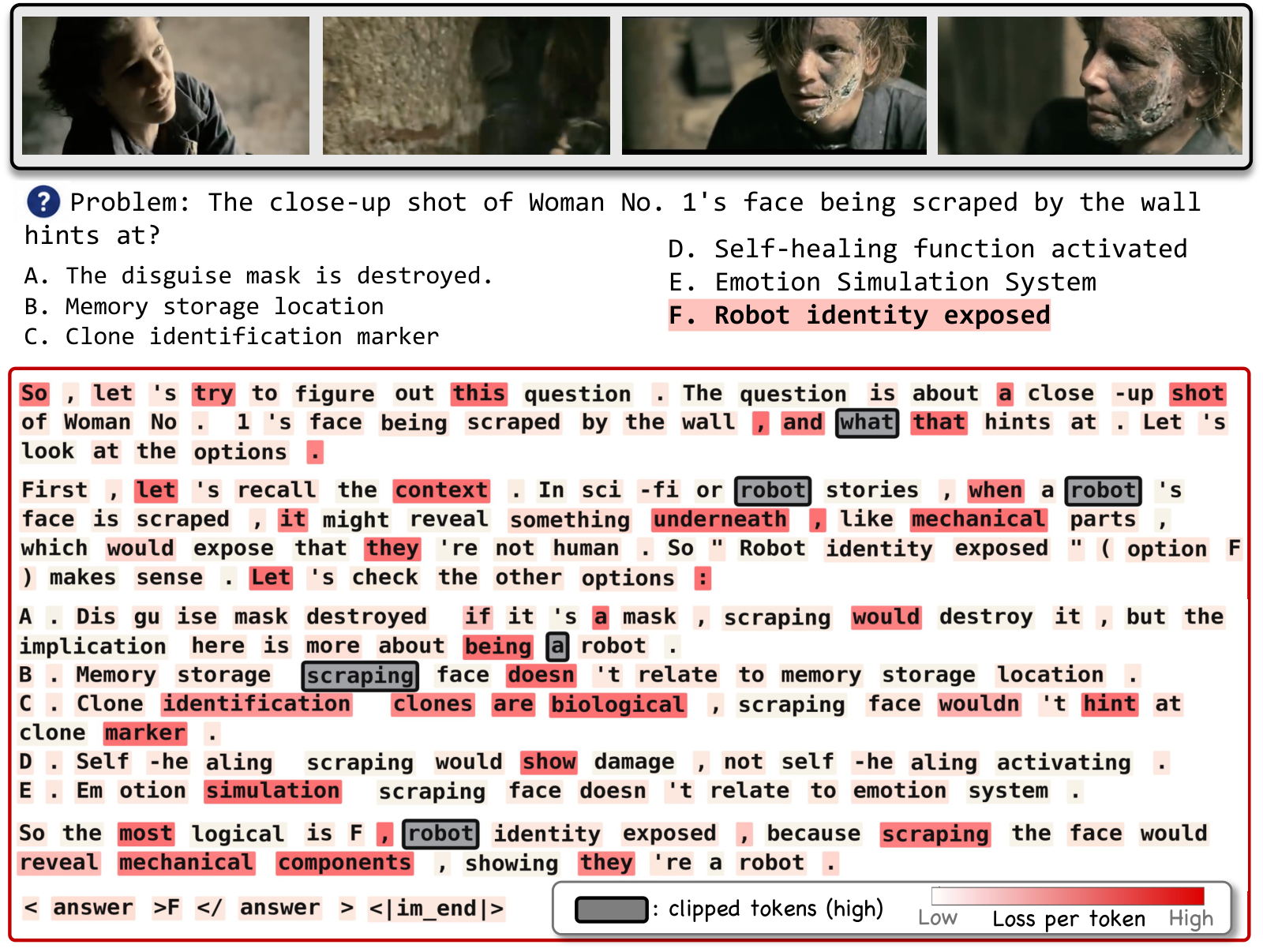
with a privileged trace from a stronger teacher (Seed1.5-VL). Here is what that trace looks like inside the update.
Training example (OneThinker, from Video-Holmes), excerpt.
Q. The close-up shot of Woman No. 1's face being scraped by the wall hints at?
The disguise mask is destroyed.
Memory storage location
Clone identification marker
Self-healing function activated
Emotion Simulation System
Robot identity exposed ✓
Privileged trace inside the Mixed-Policy GRPO update. Grey boxes are clipped tokens (no gradient);
red shading is the per-token loss.
✓ Correct answer (F)The trace gets a high reward.
✗ “robot”, “scraping” clippedThe reasons behind it get no gradient.
Comes from a stronger teacher; it is correct, so its advantage is positive (Â > 0).
2
Unfamiliar tokens
Its tokens have low probability under the student, πold(ỹt) ≈ small.
3
Ratio jumps
The update pushes them up, so the ratio exceeds 1+ε.
4
Clipped
Outside the trust region, the gradient is zero, exactly on the tokens that carry the reasoning.
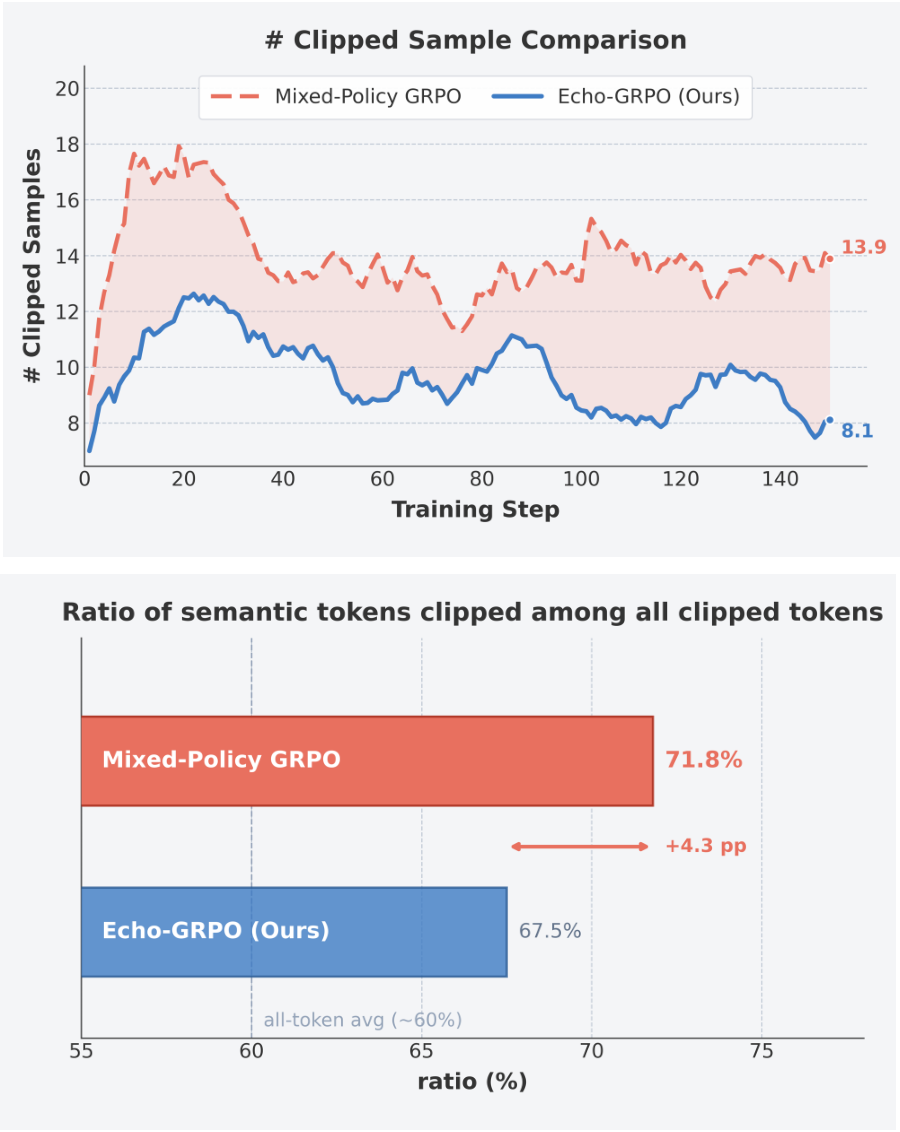
Clipping persists and targets semantic tokens.Top: samples with at least one clipped token
during training. Bottom: share of semantically important tokens (e.g., nouns from the question and options)
among clipped tokens: 71.8% for Mixed-Policy GRPO vs. 67.5% for Echo-GRPO.
Clipping method
Priv. trace
Avg.
Δ
Mixed-Policy
OOD
35.9
–
+ Unclip all tokens
OOD
40.8
+4.9
+ Unclip random tokens
OOD
48.4
+12.5
+ Unclip semantic tokens
OOD
52.0
+16.1
Echo-GRPO (Ours)
ID
58.2
+22.3
Is semantic-token clipping the cause? Restoring gradients for the same number of clipped tokens,
semantic tokens recover far more than random ones (+16.1 vs. +12.5). Avg. over VideoMMMU, MMVU and Video-Holmes (Qwen3-VL-4B).
Method
Echo-GRPO: reason in the words you speak
Instead of imitating the privileged trace, Echo-GRPO paraphrases it into the student's own idiolect
with Dual-Reference Decoding (DRD), then uses the paraphrase in place of the privileged trace in the GRPO group.
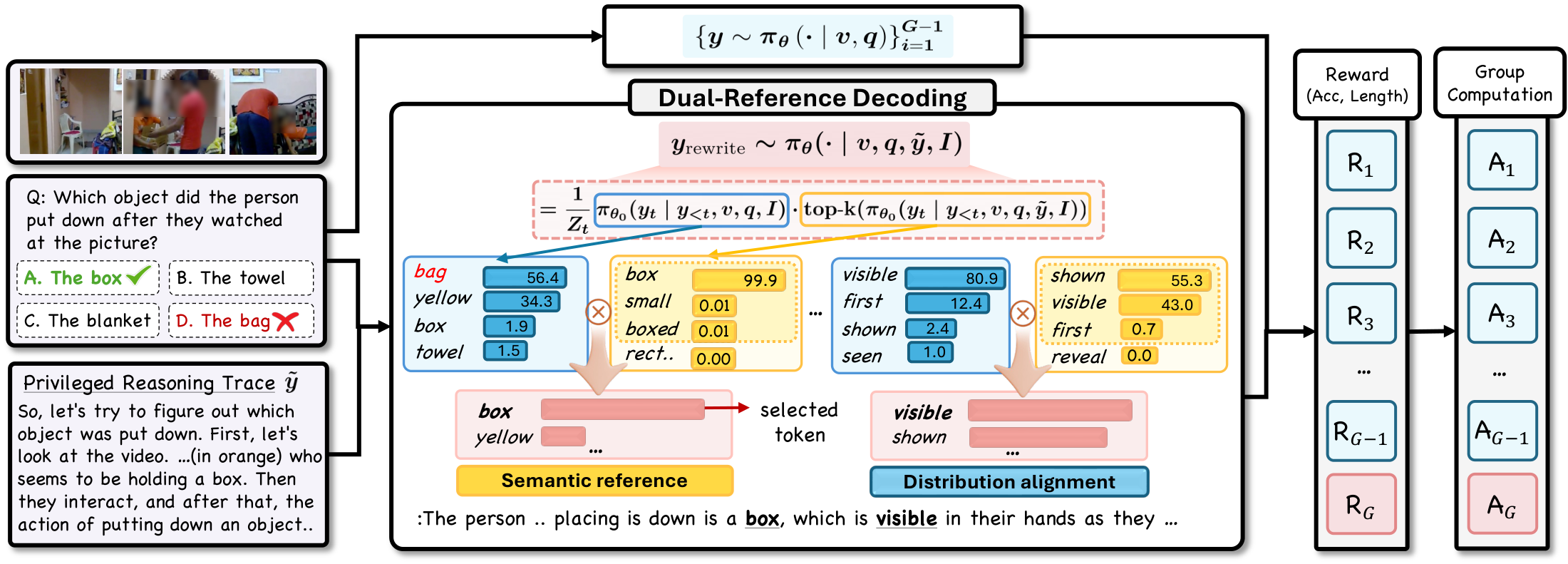
Overview of Echo-GRPO. Given a video question and a privileged trace ỹ, DRD combines two conditional
distributions of the initial policy πθ₀ as a product of experts. The semantic reference keeps token selection faithful
to ỹ (correcting ‘bag’ to ‘box’); the distributional reference prefers what the student would naturally say
among semantically equivalent candidates (‘visible’ over ‘shown’).Dual-Reference Decoding, one token at a time. The distributional reference (no trace) and the semantic reference
(top-k, conditioned on ỹ) are multiplied and renormalized; a token wins only if both agree. Probabilities are the ones shown in Fig. 3 of the paper.
The student conditioned on the privileged trace ỹ proposes its top-k next tokens, so the paraphrase stays faithful to the teacher's meaning.
Distributional reference
The student without ỹ scores the full vocabulary, so each token stays likely under the student's own distribution.
Product of experts
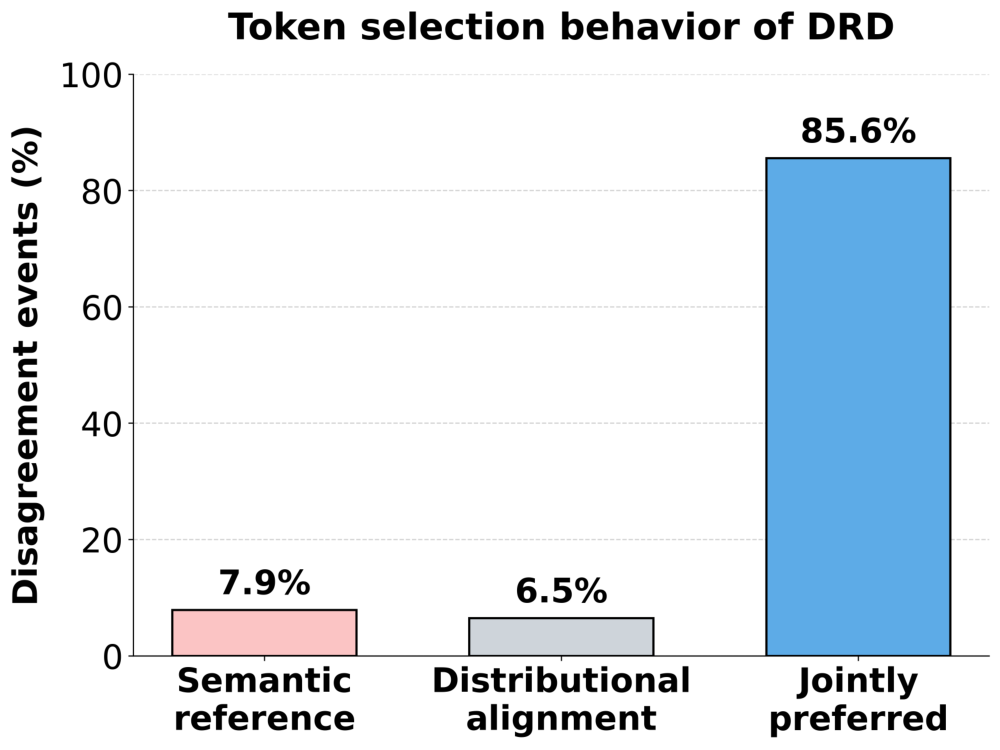
A token wins only if both references agree; when they disagree, DRD picks a token preferred by both in 85.6% of cases.
Experiments
Main results
Five video reasoning and general benchmarks, 8 frames per video. VideoEcho-R1 is trained with Echo-GRPO.
Explore the results. Pick a backbone and a benchmark. Full numbers are in the table below.
Model
VideoMMMU
MMVU (mc)
Video-Holmes
VSI-Bench
VideoMME
Avg.
InternVL3.5-4B
Base
43.4
57.4
33.9
37.5
55.4
45.5
+ SFT
54.1
59.0
40.9
42.5
57.4
50.8
+ GRPO
50.4
61.1
40.0
46.7
56.5
50.9
+ SFT → GRPO
49.8
61.3
39.4
37.8
57.6
49.2
+ Mixed-Policy GRPO
49.3
58.4
38.8
41.2
55.0
48.5
VideoEcho-R1 (4B)
55.3
65.1
41.0
44.0
57.9
52.7
Qwen3-VL-4B
Base
55.2
62.7
33.5
34.7
55.6
48.3
+ SFT
48.2
62.9
40.8
38.2
58.2
49.7
+ GRPO
56.8
68.0
43.3
50.8
60.7
55.9
+ SFT → GRPO
57.5
66.2
44.0
42.7
59.6
54.0
+ Mixed-Policy GRPO
42.1
41.9
23.6
35.2
54.5
39.5
VideoEcho-R1 (4B)
59.1
68.8
46.7
50.9
60.7
57.2
Qwen3-VL-8B
Base
56.3
60.6
36.5
40.2
60.0
50.7
+ SFT
57.0
71.0
42.7
39.8
60.7
54.2
+ GRPO
62.6
71.5
44.7
51.1
61.0
58.2
+ SFT → GRPO
61.7
69.9
44.6
46.6
60.6
56.7
+ Mixed-Policy GRPO
60.1
71.5
43.1
35.8
57.5
53.6
VideoEcho-R1 (8B)
63.6
72.3
45.1
49.1
61.1
58.2
Scroll horizontally to see all columns
57.2
VideoEcho-R1 average on Qwen3-VL-4B, +1.3 over GRPO and +7.5 over SFT.
39.5
Mixed-Policy GRPO collapses below the 48.3 base model when off-policy traces are injected naively.
+4.2 / +17.7 / +4.6
Gain over Mixed-Policy GRPO on InternVL3.5-4B, Qwen3-VL-4B and Qwen3-VL-8B.
Comparison with reasoning distillation frameworks
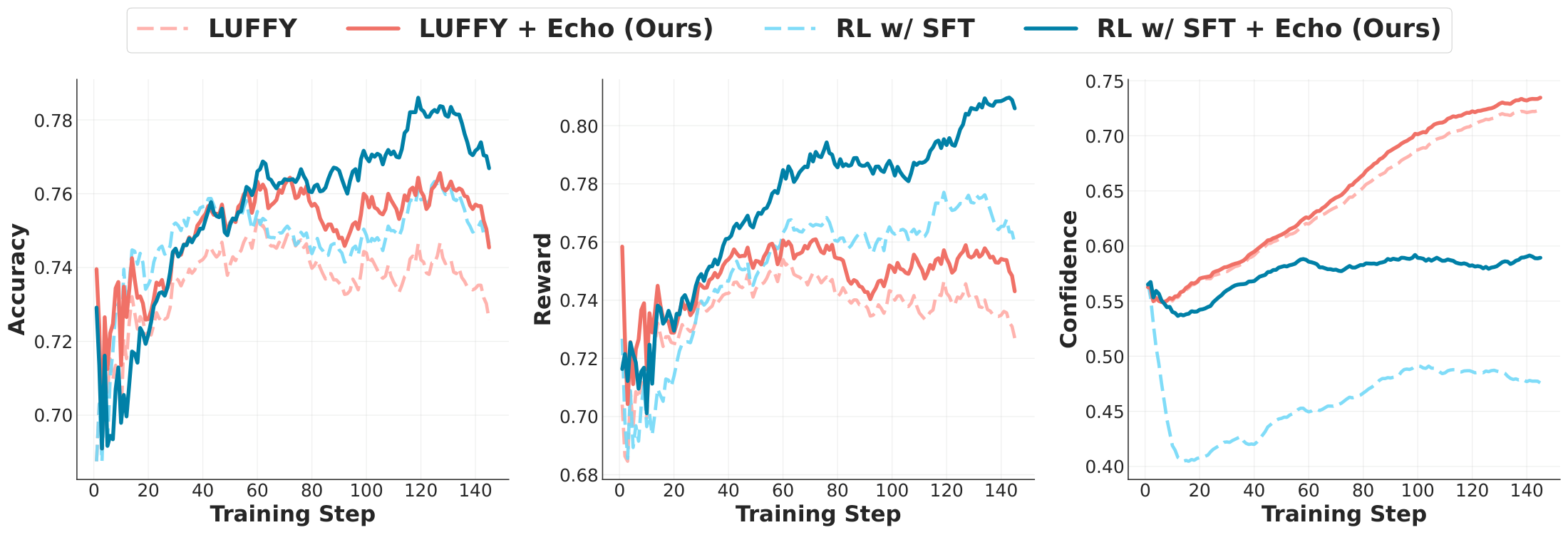
Echo-GRPO outperforms LUFFY and OPSD, and adding idiolectal paraphrasing (+ Echo) improves existing frameworks as a plug-in.
Method (Qwen3-VL-4B)
VideoMMMU
MMVU (mc)
Video-Holmes
VSI-Bench
VideoMME
Avg.
RL w/ SFT
52.8
61.0
39.1
45.5
53.5
50.4
RL w/ SFT + Echo
57.2
62.1
40.5
47.1
58.0
53.0
LUFFY∗
55.2
62.6
33.3
50.1
58.3
51.9
LUFFY + Echo
56.0
63.8
32.8
50.3
58.3
52.2
OPSD-JSD∗
56.1
63.8
36.9
50.8
55.9
52.7
OPSD-IKL∗
55.9
63.5
34.1
49.4
56.0
51.8
Echo-GRPO
59.1
68.8
46.7
50.9
60.7
57.2
∗ Frameworks originally proposed for LLMs, adapted to video question answering under the same protocol.
Idiolectal paraphrasing also improves SFT (50.6 → 52.6) and SFT → GRPO (55.9 → 58.8) on three reasoning benchmarks.
Analysis
The reasoning is now learned
Watch one GRPO update on the running example. Toggle between the privileged trace (Mixed-Policy GRPO) and its
idiolectal paraphrase (Echo-GRPO), then press play. Each token is shaded by its loss; tokens whose importance ratio leaves the trust
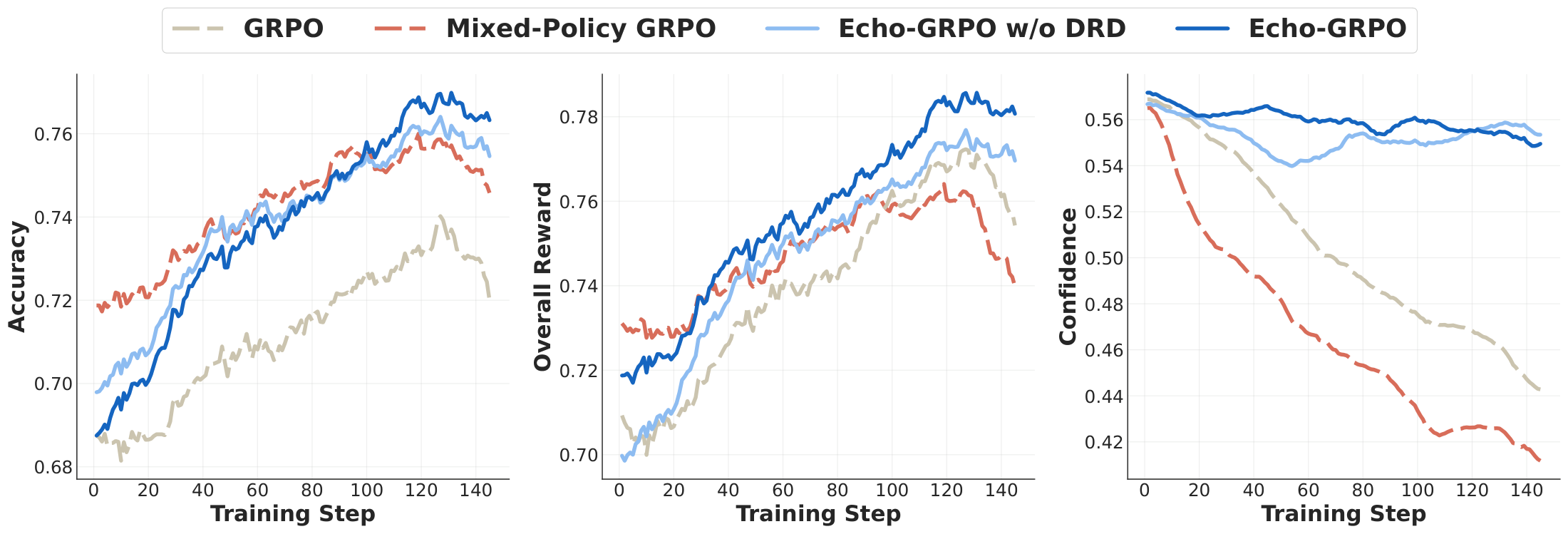
region turn grey (clipped). Hover any token for its log-probability and ratio. Data logged at the same training step for both runs.Training dynamics. Mixed-Policy GRPO starts with higher accuracy but learns slowly, while Echo-GRPO keeps
improving and surpasses all baselines. Echo-GRPO also preserves model confidence, whereas GRPO steadily declines and
Mixed-Policy collapses early.Idiolectal paraphrasing as a plug-in. Adding Echo to LUFFY and RL w/ SFT consistently improves confidence,
accuracy and reward throughout training.
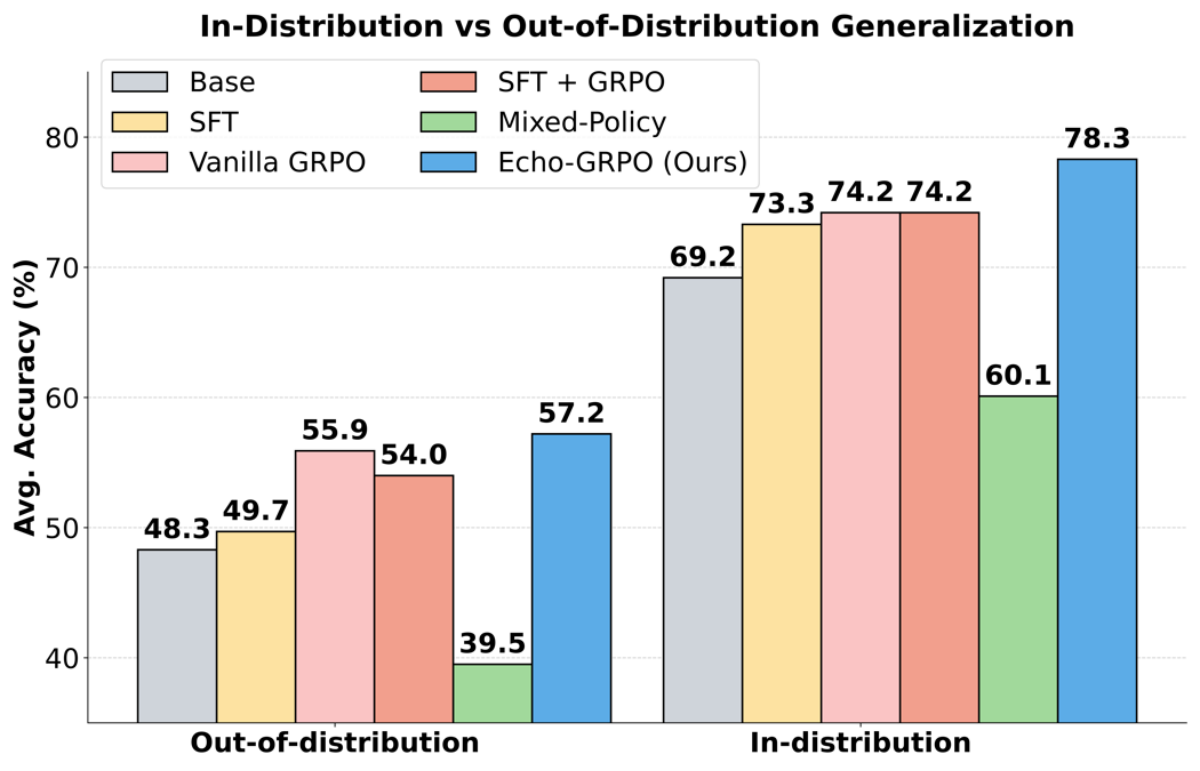
In- and out-of-distribution generalization. Echo-GRPO is best in both regimes (78.3 ID, 57.2 OOD),
suggesting it learns to reason rather than mimic.Token selection of DRD. When the two references disagree, DRD selects a token preferred by both in
85.6% of cases, supporting the product-of-experts formulation.
Grounded reasoning, not imitated format
Video-Holmes test video, played at 8× speed. Press play: both answers are typed in sync with the clip.
Q. What is the real relationship between Brandon and the shirt guy? GT: B. Kidnapper and kidnapped person
Mixed-Policy GRPO → A (neighbor) ✗“…since this is a fictional context, we need to infer based on the provided information. Wait, this is part of a very long series, so the answer is likely based on the specific narrative…”
Echo-GRPO (Ours) → B ✓“Brandon is seen entering the house, confronting the shirt guy, and later being physically restrained and threatened… This relationship is most consistent with a kidnapper and kidnapped person dynamic.”
Mixed-Policy GRPO copies the format of privileged traces and speculates; Echo-GRPO reasons from what actually happens on screen.
Full figure.
Cite
BibTeX
@inproceedings{lee2026reason,
  title     = {Reason in the Words You Speak: Idiolectal Paraphrasing
               Off-Policy Traces for Reasoning Distillation in VideoLLMs},
  author    = {Lee, {Ji Soo} and Park, Jinyoung and Lee, Seohyun and Kim, Jongha
               and Choi, Joonmyung and Yoon, Jinsung and Kim, Hyunwoo J.},
  booktitle = {NeurIPS},
  year      = {2026}
}